Structural Optimization & Aesthetic Balance
| | |
| | General Anesthesia (1–2 hours). |
| | 5–7 days for social/desk work; 4–6 weeks for full exercise. |
| | Moderate pressure/tightness (3–4/10) for the first 72 hours. |
| | Implants are durable, but routine monitoring is required. |
| | All inclusive prices start at $7,500 - $10,000 (financing available) depending on complexity and patient goals. |
Notes from the Surgeon’s Perspective
How We Design Your Result
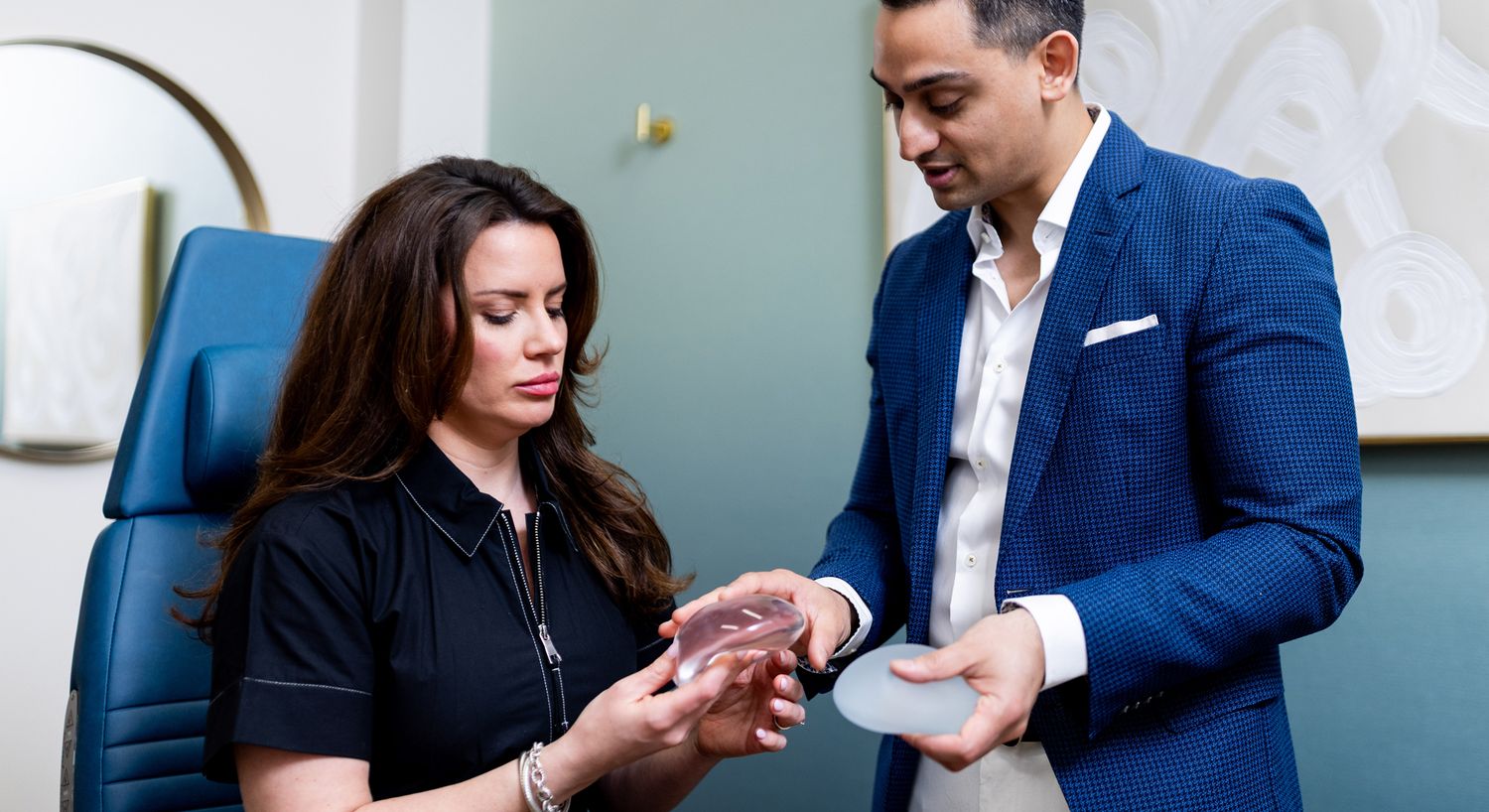
When I plan a breast augmentation procedure, I am not looking at the breast in isolation. I am looking at the "footprint" of the breast on your chest wall. This is where the math meets the art.
The Pocket Matters More Than the Implant
Most women obsess over the implant brand or the profile. In reality, the critical factor is the pocket I create. The pocket is the space inside your chest where the device lives. It dictates everything.
- The Feel: When I create a submuscular pocket (under the pectoralis muscle), I am essentially building an internal support bra using your own biology. This provides long-term soft tissue coverage, meaning you feel muscle and skin, not the edge of a medical device.
- The Precision: If the pocket is too tight, the breast feels rock hard and high. If it’s too wide, the implant slides into the armpit when you lie down (lateral displacement). I use distinct "no-touch" funnels to guide the implant into a pocket that is calculated down to the millimeter. This reduces trauma to the breast tissue and lowers the risk of capsular contracture, which is when scar tissue tightens around the implant.
Sensory Details: What You Actually Feel
When you wake up, it doesn't feel like sharp, cutting pain. It feels like you did 500 pushups yesterday. That pressure is the chest muscle stretching to accommodate the new volume. We use a multi-modal pain protocol, combining nerve blocks with prescribed medication, so most St. Louis Breast Augmentation patients rate their discomfort as a manageable dull ache (around a 3 or 4 out of 10) rather than acute pain.
The "Post-Change" Reset
Candidates for Breast Augmentation
The Pre-Pregnancy Perspective: Establishing Your Foundation
While a significant portion of our work involves restorative surgery, many of our patients are younger women looking to enhance their natural proportions before they ever consider children or major lifestyle shifts. For this demographic, the goal isn't usually restoration; it’s about establishing a silhouette that fits their frame and scales naturally with their active lives.
Proportionality Over Trends
In the age of social media, it’s easy to get caught up in fleeting aesthetic trends. However, choosing a breast implant size is a long-term anatomical commitment. We guide our pre-pregnancy patients toward "balanced enhancement"—selecting a volume that complements the width of the chest wall and the natural elasticity of the breast skin.
Selecting the right breast implant size now ensures that the results remain sustainable as your body matures. If an implant is too large for the existing breast tissue, it can lead to premature thinning of the tissue or "palpability," where the edges of the implant become noticeable to the touch.
Future-Proofing for Motherhood
A common concern for women in their 20s is how breast augmentation surgery will impact their ability to nurse later in life.
- Breastfeeding Compatibility: We typically utilize the inframammary fold (the crease under the breast) for the incision location. This approach leaves the milk ducts and the nerves around the nipple entirely undisturbed, preserving the functional anatomy required for breastfeeding.
- Placement Matters: By placing the implant behind the pectoralis muscle (submuscular placement), we provide an extra layer of structural support between the implant and the breast glands. This "internal bra" effect helps the breast maintain its shape better through the hormonal fluctuations of pregnancy.
- Tissue Longevity: Establishing a conservative, well-supported volume early on often means the breasts "bounce back" more predictably after nursing, potentially delaying or even eliminating the need for a breast lift in the future.
The "Mommy Makeover" Context
Pregnancy often leaves the upper pole of the breast looking "deflated" while the bottom remains heavy or saggy. It’s a loss of volume and a loss of elasticity simultaneously. In this scenario, simply adding a heavy implant can cause more sagging later—like putting a heavy rock in a loose sock.
We often recommend a mommy makeover approach, where we might pair a breast lift with a smaller implant. The lift tightens the skin envelope, acting like a shrink-wrap, while the implant restores the "perkiness" of your pre-pregnancy body without overburdening the skin.
The Ozempic / Weight Loss Factor
We are seeing many patients who have lost weight rapidly. This leaves loose skin that lacks the elasticity to hold an implant firmly. The structural integrity of the skin is compromised. Here, we shift our strategy to "biostructural support." We might select a specialized textured implant that grips the tissue better, or we might combine the procedure with fat grafting (using your own fat cells) to thicken the skin envelope, ensuring the implant isn't visible through the thin skin.
Placement Strategy
Submuscular vs. Subglandular
The decision of where to position the implant is a matter of biomechanics. It’s about how the weight of the device interacts with your muscle and skin over the next decade. While surgeons traditionally debated between two extremes, the modern approach at Nayak Plastic Surgery incorporates a more refined third option to ensure the implant remains imperceptible.
Submuscular (Dual Plane)
This remains a staple for many breast augmentation patients in St. Louis. By placing the implant partially under the pectoralis muscle, the muscle acts as a structural "blanket" that softens the transition from the collarbone to the breast.
- The Benefit: It creates a tapered slope rather than a sharp, rounded edge at the top of the chest. This placement also provides an additional layer of protection that historically lowers the risk of capsular contracture.
Subfascial (The Refined Middle Ground)
As surgical techniques evolve, we are increasingly utilizing subfascial placement. In this approach, the implant is tucked beneath the thin, tough lining of the muscle (the fascia) but remains on top of the actual muscle fibers.
- Why we use it: This provides the stability of a "pocket" without the recovery time or potential "animation" (movement of the implant when you flex) associated with submuscular placement. We find this particularly effective when using Motiva implants, which are designed to mimic the natural movement of breast tissue.
Hybrid Augmentation: Blending with Fat Grafting
For patients with a thinner frame or very little natural breast volume, any implant—no matter where it’s placed—can sometimes show visible edges or "rippling." To solve this, we often perform a hybrid procedure. We use fat grafting to harvest your own fat cells and strategically "soften" the borders of the implant. This bio-sculpting allows us to blend the implant into your anatomy, ensuring the transition looks like a natural curve rather than a surgical addition.
Subglandular (Over the Muscle)
In this method, the implant sits directly under the breast gland. While this was the industry standard for years, we now reserve it primarily for specific cases, such as competitive athletes who require zero interference with their chest muscle function or patients with significant existing tissue who don't require the coverage of a muscle or fascia layer.
The "Drop and Fluff" Timeline
Breast Augmentation Recovery
Real talk about the downtime. You can do this, but don't expect it to be effortless immediately.
Day 0-3: The Tightness
Following a Breast Augmentation St. Louis patients will wake up in a surgical bra or a supportive bra. Your chest will feel tight. If you have submuscular placement, you might feel muscle spasms. Pain medication helps, and muscle relaxers are often key here. You are up and walking around the house, but you aren't doing laundry or lifting kids.
Day 5-7: The Return to Function
Most Louis patients are back to desk work, driving, and short social outings. The acute pain is gone, replaced by soreness. You are off the strong stuff and managing with Tylenol or Motrin.
Week 3-6: The Gym Wait
This is the hardest part for active patients. You feel good, but your body is still healing internally. We restrict heavy lifting and bouncing (running, HIIT) for about 4 to 6 weeks to ensure optimal healing of the pocket.
Month 3-6: The Settle
Initially, your breasts will look high—like they are sitting near your collarbone. This is expected. Over a few months, the muscle relaxes, and the implants settle into their natural position. The skin softens. This is the "drop and fluff." By the six-month mark, they move like natural breasts.
Beyond the Implant
Combinations & Contouring
Sometimes, an implant alone isn't the answer. Breast procedures often need to address the skin envelope, not just the volume.
The Lift (Mastopexy)
If your nipple sits below the breast fold (ptosis), an implant won't fix the droop. It might actually make your breast look like a "Snoopy nose." In these cases, a breast lift is essential. We remove the excess skin, reshape the internal tissue, and place the nipple in a higher, more youthful position. Combining a lift with breast implants is complex but delivers the most transformative results for sagging breasts.
Fat Grafting (Hybrid Augmentation)
We can use fat transfer to fine-tune the result. We harvest fat from the abdomen or thighs via liposuction, purify the fat cells, and inject them around the edges of the implant. This is amazing for cleavage. It softens the "gap" between the breasts and hides any rippling. It’s the ultimate finishing touch for a truly natural look.
Body Contouring Combinations
Many patients combine breast surgery with a tummy tuck or liposuction as part of a mommy makeover. By addressing the breast and abdomen in one surgical procedure, you deal with one recovery period and get a complete restoration of your torso.
Safety, Risks, and Maintenance
We believe in radical transparency. While breast augmentation surgery is common, it is a significant medical decision that requires an honest look at the biological reality of healing.
Infection and Sterility
Infection is rare but taken seriously. To mitigate this, we employ a strict "no-touch" technique using a Keller Funnel, which allows the implant to slide into the pocket without ever touching the patient's skin. We also use triple-antibiotic irrigation to cleanse the surgical site. These protocols are designed to prevent biofilm formation, which is the primary cause of early-stage complications.
Capsular Contracture
The body naturally forms a capsule of scar tissue around any foreign object. In most people, this remains soft and undetectable. In a small percentage of cases, that tissue tightens and squeezes the implant, causing firmness or visible distortion. Our use of submuscular or subfascial placement and sterile handling techniques are our primary defense against this response.
Implant Malposition
Malposition occurs when an implant shifts from its intended pocket, leading to "bottoming out" or lateral displacement. This is often the result of poor pocket construction or choosing an implant size that is too heavy for the patient’s breast skin to support. Dr. Nayak’s precise measurements during the planning phase ensure the pocket is tight and anatomically correct, keeping the implant centered and stable.
Implant Rupture
Modern devices are incredibly durable, but they are not lifetime devices.
- Saline: If a saline breast implant leaks, it deflates noticeably over 24 to 48 hours. The saline solution is harmlessly absorbed by the body.
- Silicone: If a silicone gel implant ruptures, it is often "silent," as the gel is designed to stay within the shell or the surrounding scar tissue. We recommend routine ultrasound or MRI monitoring to ensure implant integrity as the devices age.
Breast Implant Illness (BII)
Some patients report systemic symptoms, such as fatigue or joint pain, which they attribute to their implants. While current scientific data has not established a direct causal link for the majority of patients, we listen to every concern. If you feel your implants are negatively affecting your health, we support your decision for explantation (removal). We are your partners in long-term health, not just your initial aesthetic.
“The Nayak experience
is amazing!”
“I can honestly say that Dr. Nayak is one of the most talented and knowledgeable surgeons out there. After years of research, I chose him for my rhinoplasty. My trust in his expertise and genuine care led me, someone very cautious, to give him complete discretion to craft my rhinoplasty as he saw fit.”
— Jason Jackson, St. Louis Medspa Patient